
Nullam dignissim, ante scelerisque the is euismod fermentum odio sem semper the is erat, a feugiat leo urna eget eros. Duis Aenean a imperdiet risus.
Nullam dignissim, ante scelerisque the is euismod fermentum odio sem semper the is erat, a feugiat leo urna eget eros. Duis Aenean a imperdiet risus.
 author
An LED display may contain dozens or hundreds of power supplies, depending on its size, module load, cabinet design, and required redundancy. Buyers sometimes estimate the quantity from screen area alone, but this can produce an inaccurate result. The power-supply layout should be calculated from the electrical load inside each cabinet, while total screen wattage is used mainly for upstream power distribution, circuit protection, generators, and electricity-cost estimates.
A reliable design needs enough capacity for peak operating conditions without forcing each power supply to work continuously at an unsuitable load or temperature. It should also consider what happens when one unit fails.
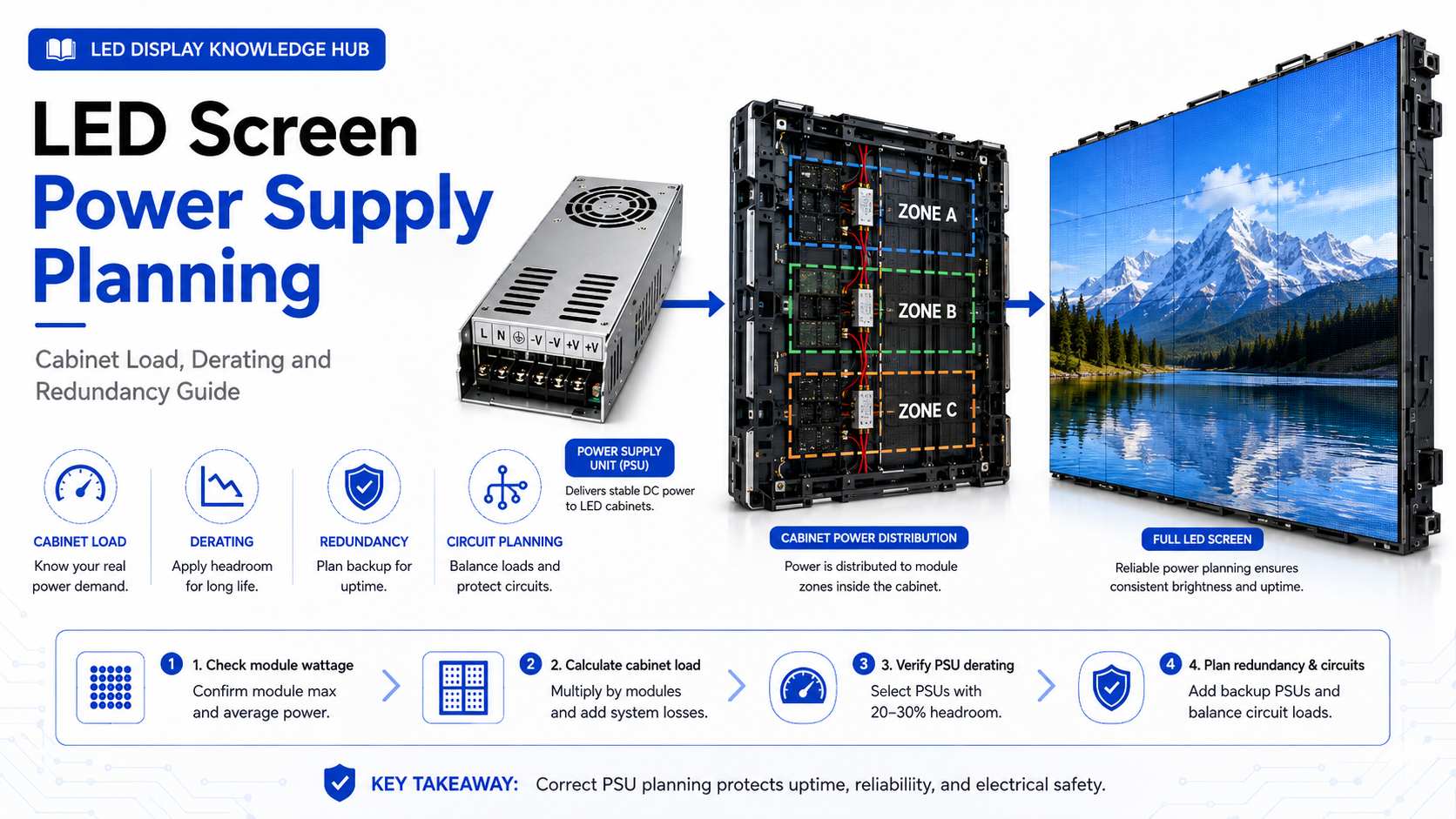
LED display specifications commonly provide average and maximum power consumption per square meter. These numbers are useful, but they serve different purposes.
Longcheng‘s published guidance notes that maximum power consumption is more useful for electrical circuit design and safety planning, while average power consumption is more suitable for estimating normal electricity bills.
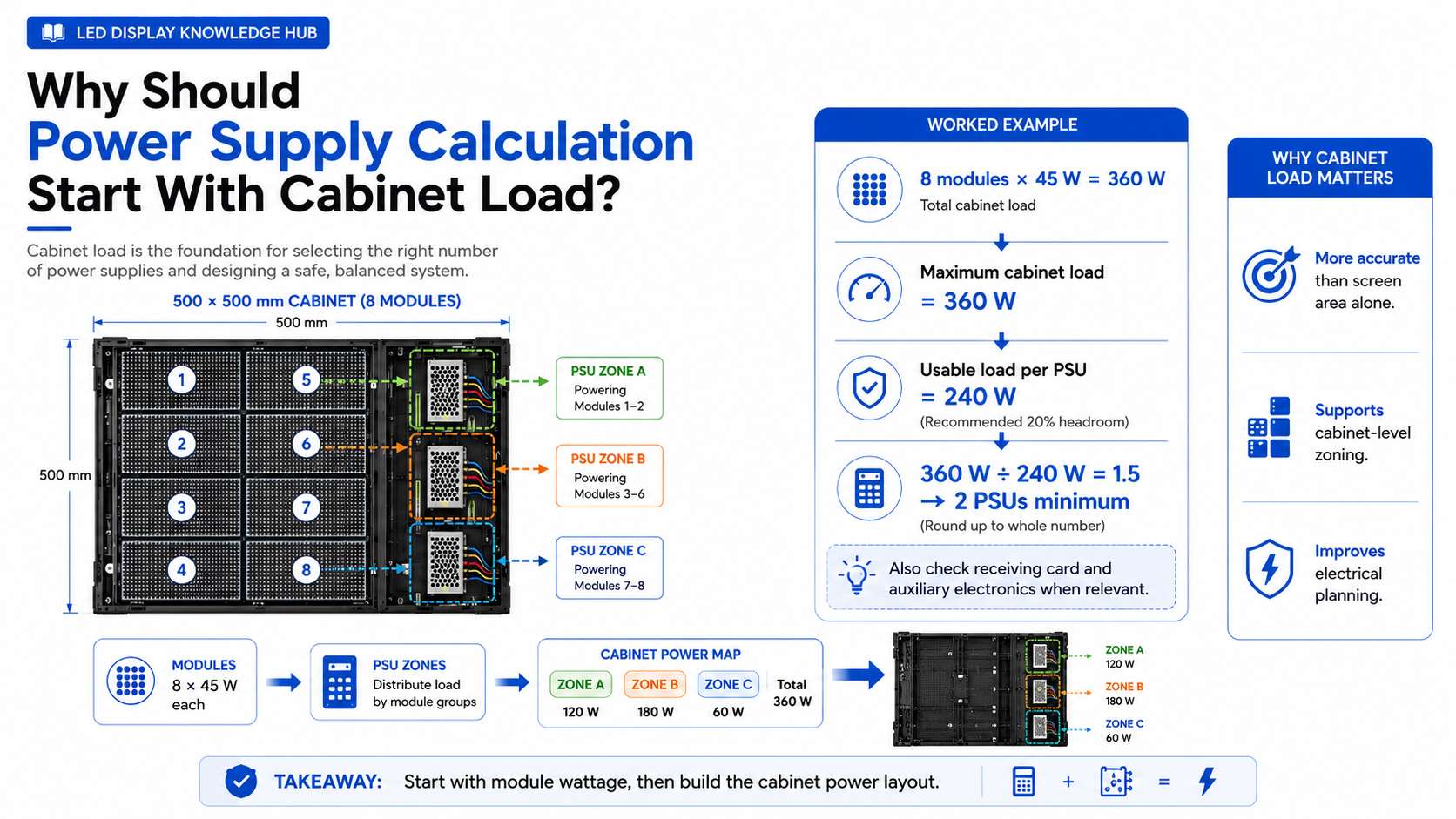
Inside a cabinet, the engineering calculation should begin with the maximum DC load of the LED modules and other components supplied by each PSU.
Suppose the modules connected to one power supply can draw a maximum of 180 W. If the selected power supply is rated for 300 W under the actual installation conditions, the design load is 60% of its rated output.
If the same PSU were assigned 295 W of maximum module load, the component count would fall, but the available margin would become much smaller. This could make thermal conditions and temporary peak loads more important.
The correct margin should come from the specific power-supply datasheet and cabinet thermal design rather than from one universal percentage.
Running a power supply below its absolute maximum rating can provide useful operating margin, particularly when cabinet temperatures rise or input conditions change.
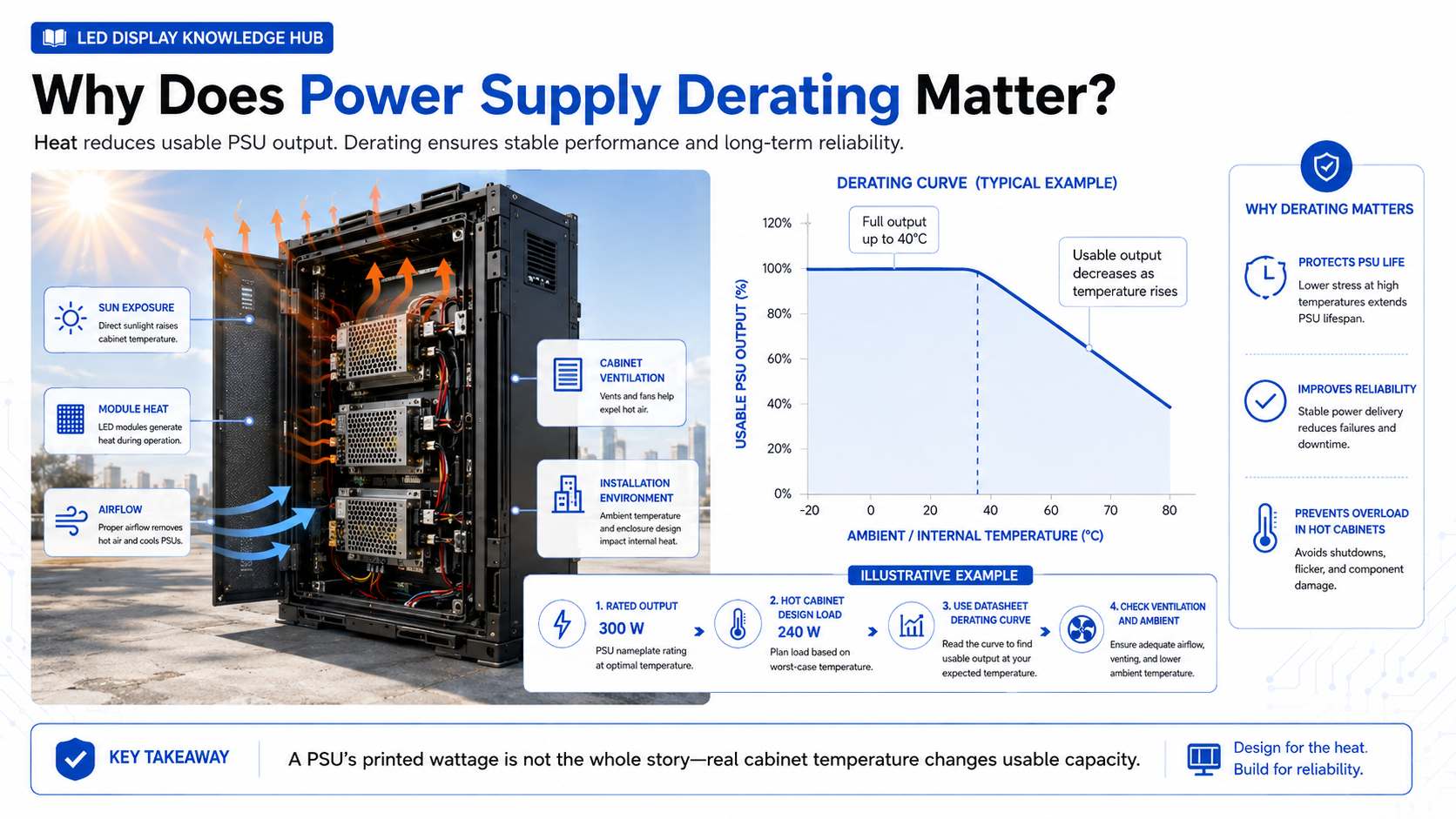
MEAN WELL’s display power-supply guidance specifically recommends adding margin to actual power usage when selecting a power supply to support longer service life. It also notes that rated output may need to be derated at elevated ambient temperatures.
A power supply mounted inside an LED cabinet does not operate in the same environment as a unit tested on an open workbench. Heat from LED modules, driver ICs, sunlight, enclosed cabinet space, and neighboring power supplies can raise the internal temperature.
MEAN WELL gives an example in which a power supply requires output derating once ambient temperature rises above a specified level, and it stresses that thermal management should be considered during system design.
This is particularly important for outdoor LED billboards and high-brightness screens. Increasing the PSU rating does not solve poor ventilation by itself; cabinet heat dissipation, airflow, installation orientation, and environmental temperature must be checked together.
The safest method is to work from cabinet-level or module-level electrical data rather than multiplying screen area by a generic PSU count.
First determine the maximum load connected to the power supply:
Maximum assigned load = combined maximum load of connected modules and electronics
Then check the usable output of the selected PSU under the expected temperature, input voltage, and installation orientation.
The basic quantity can then be estimated as:
Power supply quantity = total DC load ÷ approved usable load per PSU
Always round upward, because a fraction of a power supply cannot be installed.
For example, imagine one cabinet has 720 W of calculated maximum DC load. If the approved design allows each selected PSU to supply 240 W under the project’s conditions, the cabinet needs:
720 ÷ 240 = 3 power supplies
If thermal derating reduces usable capacity, the calculation must be repeated. The electrical drawing should therefore be finalized after the actual cabinet configuration and PSU model are confirmed.
Not every LED display needs the same level of redundancy. A small retail screen that can be serviced immediately has a different risk profile from a control-room wall, broadcast studio, stadium screen, or major outdoor advertising display.
Redundancy should be treated as a business decision as well as an electrical one.
If one power-supply failure causes only a small non-critical section to go dark and the component can be replaced quickly, additional redundancy may provide limited financial benefit.
If the display supports a live television production, ticketed event, high-value advertising contract, traffic information system, or another uptime-sensitive application, the cost of failure can be much higher than the cost of additional power hardware.
Longcheng’s fault-handling process illustrates the operational importance of these components. Its service documentation treats individual damaged power supplies as replacement-level faults, while widespread power-supply or module damage is categorized as a more serious failure requiring on-site support.
The design goal should therefore be to limit how much screen area is affected by a single failure and to make replacement straightforward.
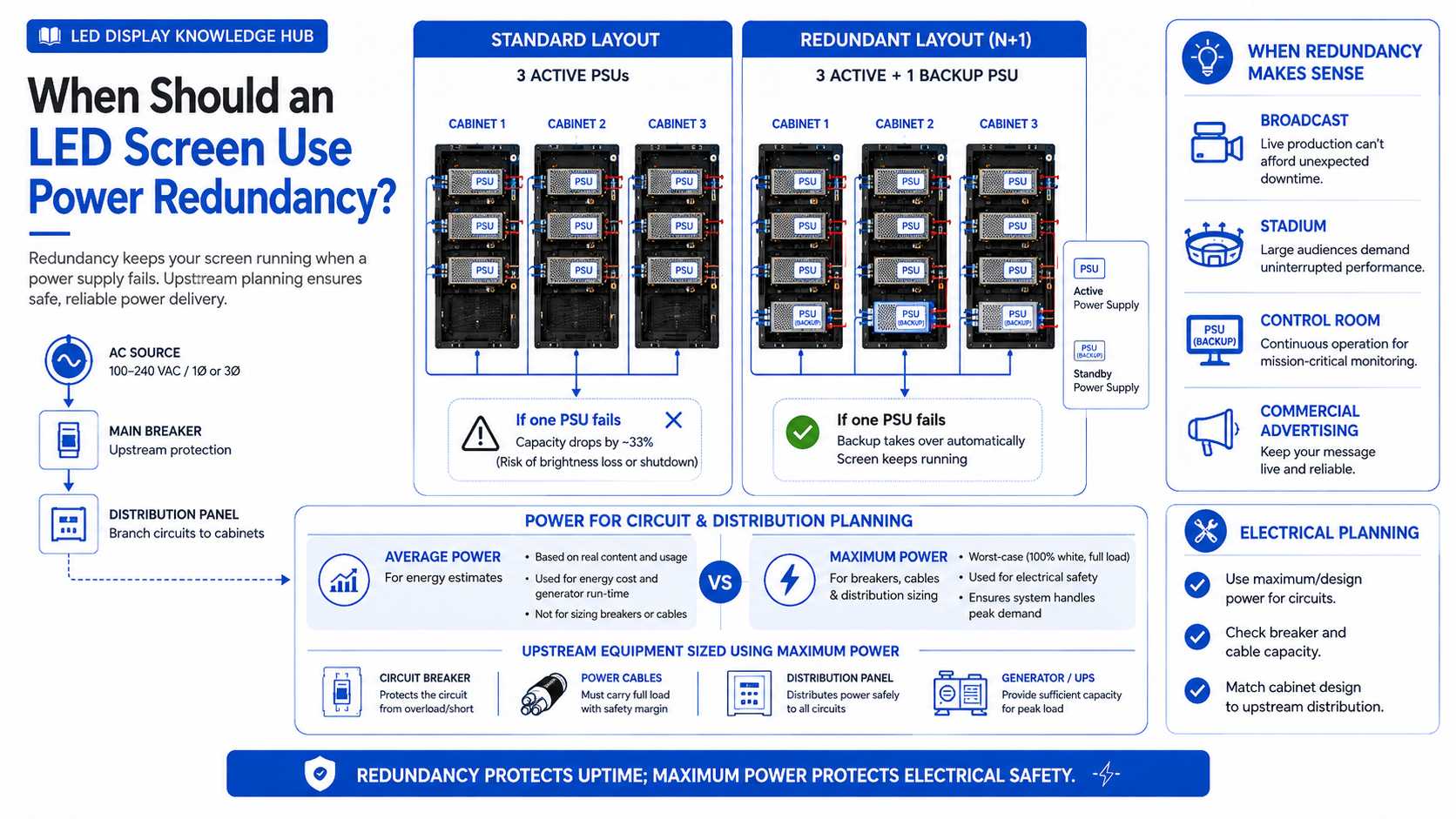
Using fewer power supplies can reduce initial component cost, wiring, connectors, cabinet space, and assembly labor. However, pushing each unit closer to its limit may increase thermal stress or enlarge the screen area affected by one failure.
Using more supplies creates the opposite trade-off. Initial cost and component count rise, but each PSU may serve a smaller load zone and maintenance can become easier.
The useful comparison is total cost of ownership rather than PSU purchase price alone.
Energy efficiency affects electricity cost and cabinet heat. Additional heat may increase cooling requirements, especially in outdoor or enclosed installations. Maintenance labor, spare stock, emergency shipping, access equipment, and advertising or event downtime can also exceed the price of the failed power supply itself.
The cheapest design on a bill of materials is therefore not automatically the lowest-cost design over several years of operation.
Confusing these two values is a common cause of inaccurate quotations and electrical planning.
Average consumption is more useful for estimating normal energy use because real video content does not keep every LED at maximum output continuously. Brightness settings, content color, ambient-light control, and daily operating hours all affect actual consumption.
Maximum consumption serves a different purpose. Engineers use it to size circuits, cables, distribution equipment, breakers, and other infrastructure for demanding operating conditions.
A project can therefore have a relatively moderate average electricity bill while still requiring electrical infrastructure capable of safely supporting a much higher peak load.
Spare PSU inventory should follow the same risk-based logic used for spare LED modules.
A small indoor screen with local service support may need only a limited reserve. An overseas outdoor billboard, rental fleet, stadium screen, or revenue-critical installation should consider supplier lead time and the financial effect of downtime.
A replacement power supply should match required output voltage, current capacity, dimensions, connector arrangement, safety requirements, and operating environment. Replacing a PSU with a unit that merely “fits” physically can introduce electrical or thermal problems.
Spare units should therefore be documented by project and cabinet type, stored in a dry environment, and tested as part of commissioning or scheduled maintenance.
The number of power supplies an LED screen needs cannot be determined accurately from screen size alone. The correct calculation starts with the maximum electrical load assigned to each power zone and then checks the selected PSU’s rated output under real operating temperature, input voltage, and installation conditions.
Adequate load margin, sensible redundancy, good thermal design, and compatible spare stock can reduce failures and shorten repair time. Buyers should compare these benefits with initial hardware cost rather than simply minimizing the number of PSUs in the quotation.
A well-designed power system protects more than the LED modules. It protects uptime, maintenance budgets, advertising revenue, event schedules, and the long-term return on the complete display investment.
Watts per square meter is useful for estimating whole-screen power demand, but final PSU quantity should normally be calculated from the module and cabinet electrical layout. Each supply must be matched to the actual load connected to it.
A power supply may be rated to deliver its specified output under defined conditions, but project designers should follow the manufacturer’s load and temperature derating data. Adding appropriate margin can improve reliability, particularly in hot or enclosed cabinets.
They may justify a larger reserve because outdoor systems can have longer service lead times, difficult access, harsher temperatures, and higher downtime costs. The correct spare quantity depends on project scale, service response time, and operational importance.











Leave a comments