
Nullam dignissim, ante scelerisque the is euismod fermentum odio sem semper the is erat, a feugiat leo urna eget eros. Duis Aenean a imperdiet risus.
Nullam dignissim, ante scelerisque the is euismod fermentum odio sem semper the is erat, a feugiat leo urna eget eros. Duis Aenean a imperdiet risus.
 author
A fixed outdoor LED screen can pass a factory inspection and still disappoint on its first sunny afternoon. The image may be difficult to read from the pavement; a cable gland may sit where rainwater collects; or the night-time setting may be uncomfortable for nearby windows. None of those problems can be settled by the words “high brightness” and “IP66” on a quotation.
The useful question is not whether the catalog has the right numbers. It is whether the installed wall performs as agreed at the real site. This guide separates the evidence a buyer should obtain from a manufacturer from the checks an installer can complete before handover.
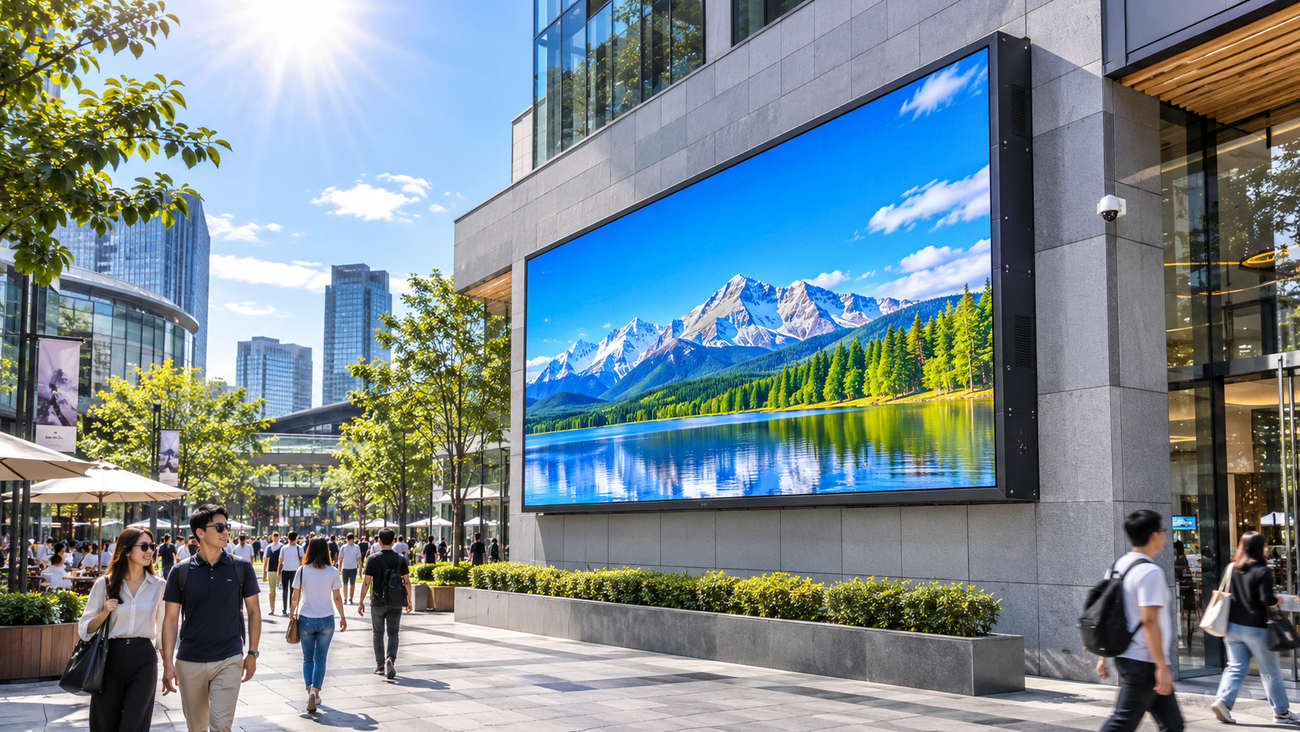
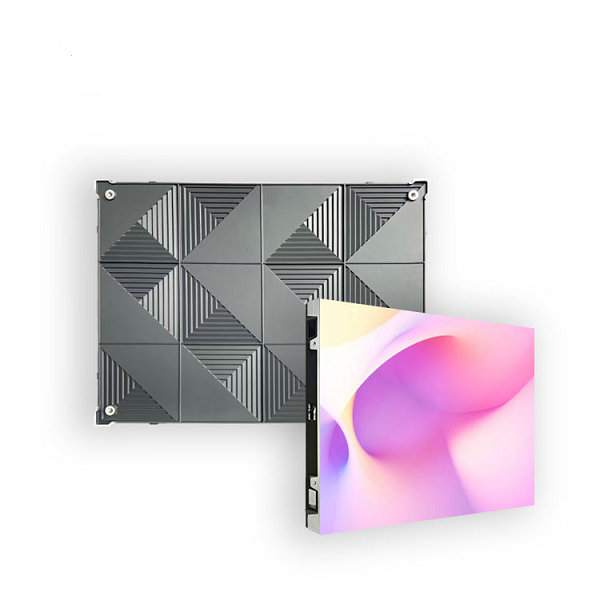
Figure 1. Illustrative outdoor LED display in a retail plaza; application visualization, not an actual project photograph.
Brightness is usually stated as luminance in cd/m², commonly called nits. It describes light emitted toward an observer, not the amount of sunlight falling on the screen. IP ratings describe the resistance of an enclosure under defined test conditions. Neither number, by itself, verifies that a finished display has the right contrast, drainage or cable-entry protection.
Longcheng’s ES960 outdoor energy-saving LED screen lists 5,000 cd/m² for P4.4, 5,500 cd/m² for P5.7 and P6.67, and 6,000 cd/m² for P8 and P10. The same published table lists IP66 cabinet protection, a refresh rate of at least 3,840 Hz, and front-and-rear service access. Those are product-family references; the accepted configuration, measurement conditions and installation details still need to be documented.
A useful brightness test has two parts. First measure the screen under repeatable conditions, so a later service visit can reproduce the result. Then judge legibility in the lighting conditions people will actually encounter. Mixing the two can produce a flattering measurement without answering the operator’s problem.
Use a calibrated luminance meter and follow the agreed measurement method. Record the selected model and pixel pitch, the brightness-control setting, the test image, the viewing geometry, the meter, and the screen’s warm-up state. Take readings at agreed representative positions rather than one convenient bright spot. For uniformity, compare the positions with the tolerance agreed before testing; the product page does not publish a project acceptance tolerance.
A full-white pattern is useful for documenting a high-output state, but it does not represent ordinary advertising. Repeat the observations with actual campaign content, including the smallest approved text, low-contrast images and the darkest background expected in service. Record both the measurement and whether the message can be read from its planned audience zone.
A screen that looks strong at dusk may lose contrast when low-angle sunlight strikes the face. If the site permits, view it from the primary approach during the hours that create the worst glare. Note the sun direction, nearby reflective glass, display angle and content shown. Do not substitute a casual noon photograph for the controlled luminance measurement: a camera’s automatic exposure can conceal the difference between two settings.
At night, test the scheduled dimming or ambient-light response rather than leaving the daytime output in place. Confirm how the controller behaves when a sensor is shaded, disconnected or reporting an implausible value. Local brightness restrictions may also apply; the correct night setting is a site decision, not simply the cabinet’s maximum capability.
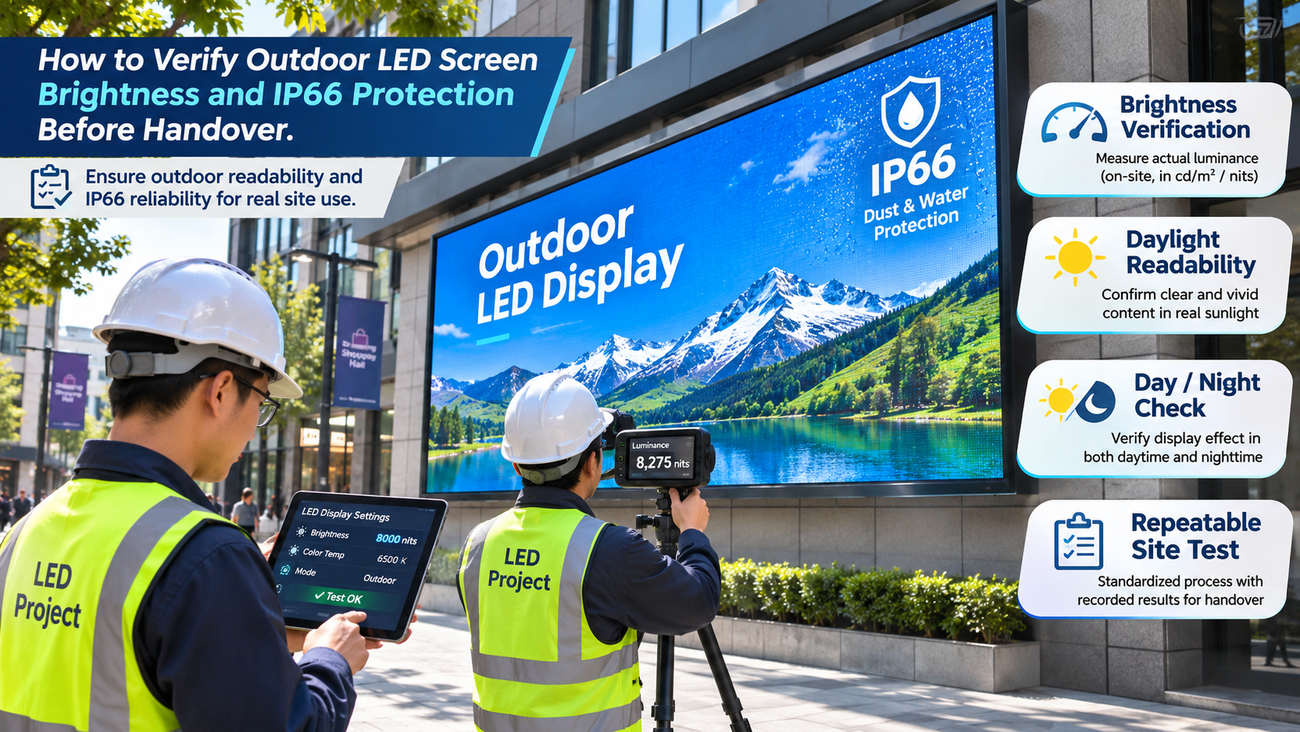
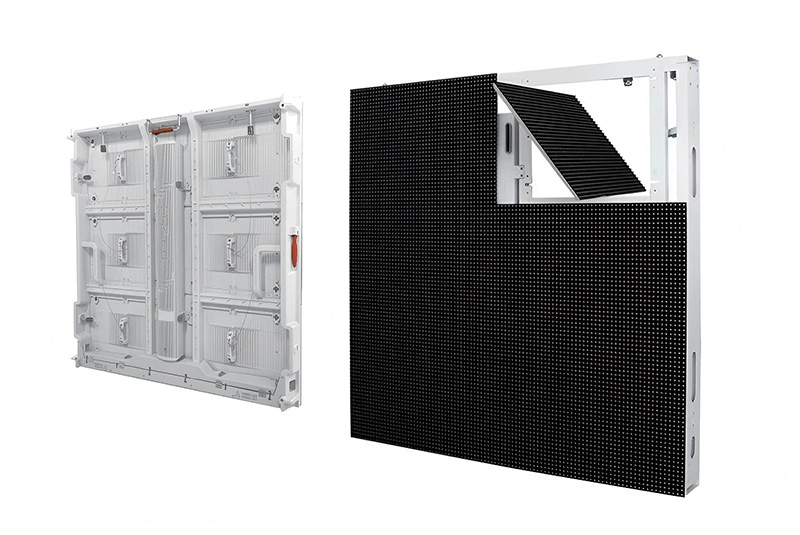
Figure 2. Illustration of a site luminance and daylight-readability check. Any numerical readings shown are fictional examples, not product test data.
Under IEC 60529, the first “6” means dust-tight protection and the second “6” addresses powerful water jets under standardized conditions. It does not mean the screen is qualified for immersion or that any installer may spray a powered wall with high-pressure cleaning equipment. Intertek’s explanation of IP testing is a useful reference for what the enclosure code measures.
The important distinction is the test boundary. An IP66 cabinet can be joined to an inadequately protected site connector or penetrated by a poorly sealed cable entry. A complete outdoor wall also has structural joints, access doors, cable paths and interfaces with the mounting frame. Those details are not automatically certified because the cabinet carries a rating.
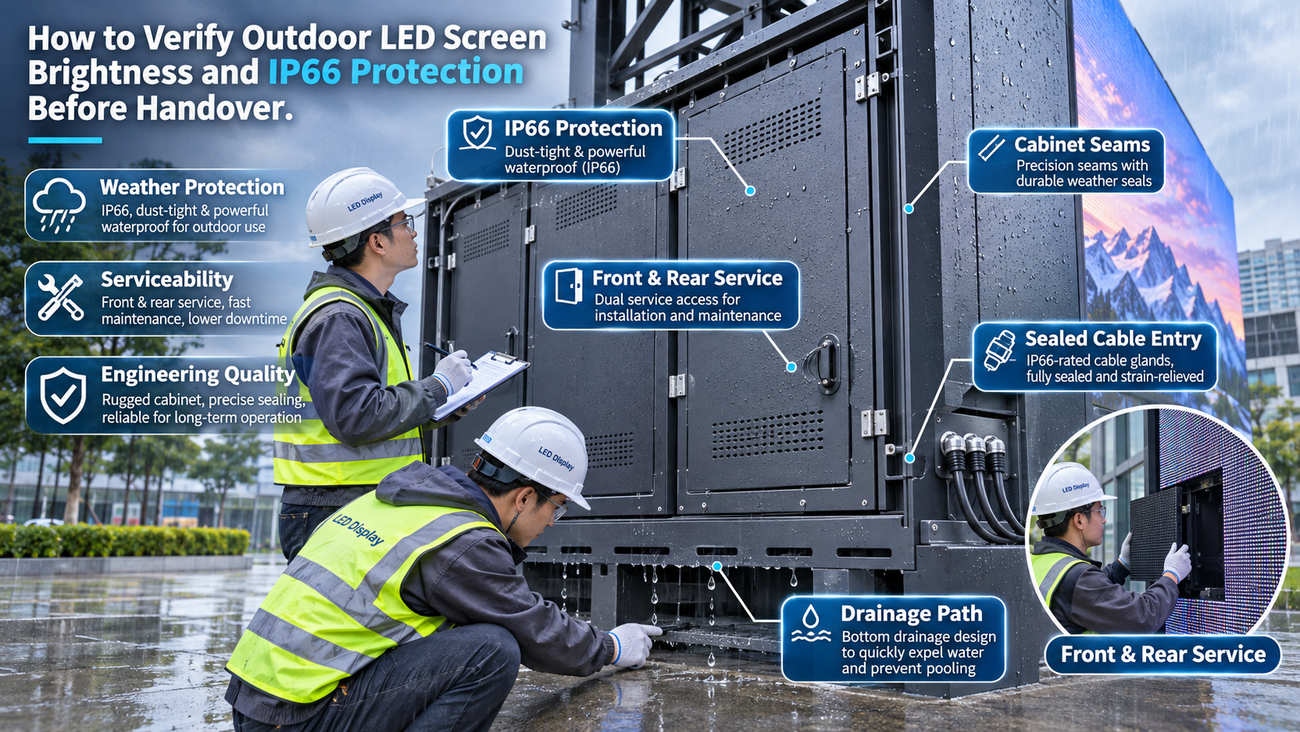
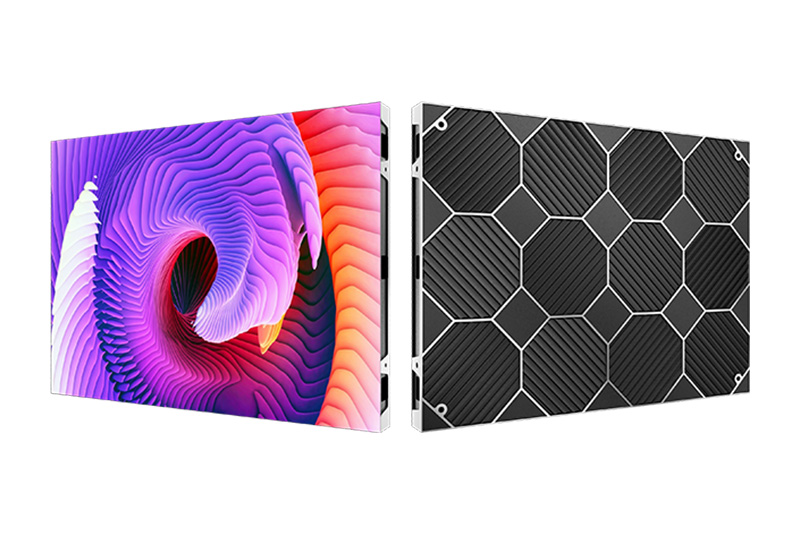
Figure 3. Illustration of cabinet seals, cable entry and drainage inspection; not a certified IP66 laboratory test or an ES960 product photograph.
Cable glands, connector housings and unused openings: confirm the actual fittings and installation method used, not only their catalog rating.
Cabinet seams and access doors: check seating, damage, compression and the manufacturer’s prescribed sealing procedure before closing the wall.
Water paths: look for exposed upward-facing connectors, trapped water, blocked drainage and routes that could carry runoff into a power box.
Service work: verify how a technician can reopen and reseal the unit without compromising the approved installation.
Keep any controlled water-ingress test within an approved method, with suitable isolation and qualified personnel. A field hose test is not a substitute for a documented IEC 60529 laboratory result. After approved testing or rainfall, an electrician should investigate signs of moisture before equipment is energized or returned to service.
A handover report is most useful when it distinguishes factory evidence, installation inspection and operating observations. It should identify who performed each check, when it happened, what was tested, and how exceptions were closed.
|
Evidence |
What to record |
Why it matters |
|---|---|---|
|
Factory / model |
Exact cabinet series; relevant IP report or declaration; approved technical sheet |
Confirms the specification applies to the supplied configuration |
|
Brightness |
Meter, test content, settings, readings, positions, agreed tolerance |
Creates a repeatable visual baseline |
|
Day / night viewing |
Viewing points, sun conditions, real content, dimming schedule |
Proves operational legibility and avoids excessive night output |
|
Sealing / drainage |
Annotated installation photos, connector details, re-entry procedure |
Connects the enclosure claim to the completed site |
|
Sign-off |
Defects, corrective actions, retest evidence, responsible parties |
Prevents unresolved items from disappearing at handover |
If a defect is found, record a retest against the same condition. A changed brightness profile, replacement module or revised cable route should not be signed off only because the screen turns on. The return visit needs to check the issue that originally failed.
Not every site needs the same enclosure or brightness envelope. Longcheng also lists an outdoor P5 fixed LED billboard with a published IP65 rating and a 5,500-nit standard brightness. The ES960 and that P5 product should not be treated as the same cabinet or as interchangeable certifications. Compare the required exposure, viewing conditions and accepted model-specific evidence instead of choosing by a single larger number.
For projects where long-term access is difficult, include maintenance procedures and replacement arrangements in the handover. Longcheng describes remote support, on-site maintenance and installation assistance on its service page, but the order should specify which services apply at the destination. If the site needs a formal acceptance procedure, send its exposure conditions and the draft test sheet through the contact page before production.

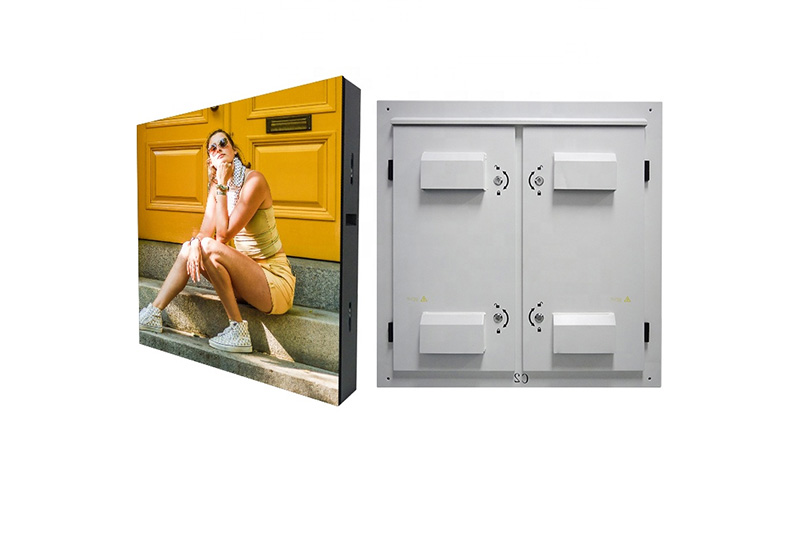
Figure 4. Illustration of site acceptance, inspection records and service handover; not documentation of a completed customer project.
No. The rating describes enclosure protection under specified tests. Field connectors, frame interfaces, damaged seals and maintenance work can create additional water paths.
Not automatically. Sun angle, screen orientation, display content and local operating rules affect the result. Compare the correct model at the site’s planned viewing positions and brightness schedule.
No. Automatic exposure and image processing make it unreliable as a luminance meter. A photo can document viewing context, but a calibrated instrument is needed for a repeatable measurement.
Record the condition, responsible party and corrective action. Retest that same condition and keep the result with the approved drawings and service record.












Leave a comments