
Nullam dignissim, ante scelerisque the is euismod fermentum odio sem semper the is erat, a feugiat leo urna eget eros. Duis Aenean a imperdiet risus.
Nullam dignissim, ante scelerisque the is euismod fermentum odio sem semper the is erat, a feugiat leo urna eget eros. Duis Aenean a imperdiet risus.
 author
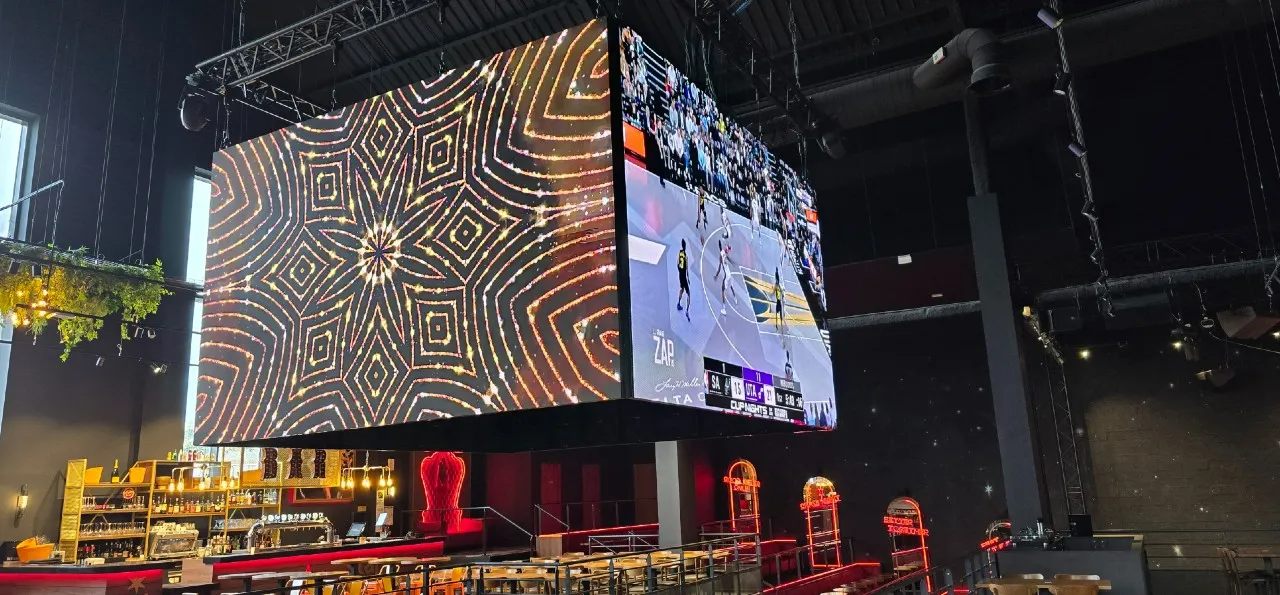
A cube LED display can turn unused overhead or central-floor space into a multi-directional digital canvas. Its commercial value, however, does not come from the shape alone. Buyers must coordinate viewing distance, active faces, content resolution, structural support, heat management and service access before production. A cube that looks impressive in a rendering can become expensive to install or difficult to maintain if these decisions are postponed.
AVIXA notes that LED signage usually requires a higher initial investment than printed signage and recommends budgeting for mounting infrastructure, content management, installation and ongoing maintenance—not only the display hardware. The same source identifies avoided reprinting, reusable hardware and sponsor inventory as potential returns. These points are especially relevant to a multi-face creative LED display, because every additional face adds pixels, content work and service considerations.
Start with the site and business objective rather than a catalogue size. A suspended cube in an exhibition hall has different structural and sightline requirements from a floor-mounted unit in a retail atrium. Record the nearest and farthest viewers, mounting height, available power, operating hours, content source, access restrictions and whether cameras will record the screen.
Four active vertical faces suit many suspended applications because visitors approach from different directions. A fifth top face is often invisible, while a bottom face matters only when viewers can stand beneath the installation. Paying for unseen faces raises module, controller and power costs without improving communication. Map pedestrian paths first, then activate only the surfaces that have measurable exposure.
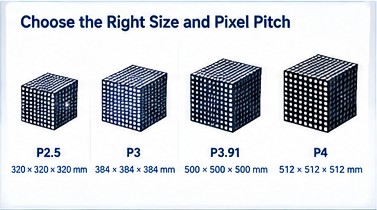
Longcheng’s Creative Cube LED Display lists P2.5 at 320 × 320 × 320 mm, P3 at 384 × 384 × 384 mm, P3.91 at 500 × 500 × 500 mm and P4 at 512 × 512 × 512 mm. These sizes are useful starting points, not automatic prescriptions. A smaller pitch supports closer viewing and finer text, but it also increases pixel count and processing demand. At longer distances, a larger pitch may deliver comparable perceived detail at a lower cost.
| Configuration | Typical Decision Logic | Main Cost Effect |
| P2.5 / 320 mm | Close viewing; compact retail or exhibit feature | Higher pixel density and content detail |
| P3 / 384 mm | Balanced size for indoor directional viewing | Moderate processing and structure |
| P3.91–P4 / 500–512 mm | Longer viewing distance; larger visual object | Lower density, but more physical area |
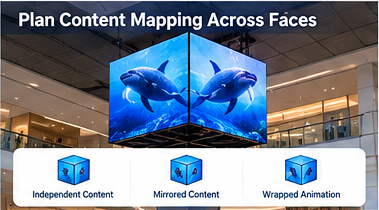
Content planning should begin before the processor and cabinet layout are frozen. The designer must decide whether each face shows an independent message, all faces mirror the same feed, or one animation wraps around the cube. Independent feeds need more input management. Mirrored content is simpler but may waste the geometry. Wrapped animation produces the strongest spatial effect, yet poor corner alignment can split logos, faces or text.
Provide a face-by-face pixel map, safe zones near each edge, the orientation of every face and a preview template showing the assembled cube. Build campaign files at native resolution whenever possible. Avoid placing small text across a corner, and test motion direction from actual audience routes. A 10-second loop should also be checked for synchronization after repeated playback, not only during a single preview.
The eye compares adjacent faces at the edges, so brightness or color differences that seem minor on separate panels become obvious on a cube. Factory calibration should be followed by assembled testing. The acceptance process should examine corner seams, grayscale consistency, white balance, refresh behavior on camera and whether replacement modules retain usable calibration data.
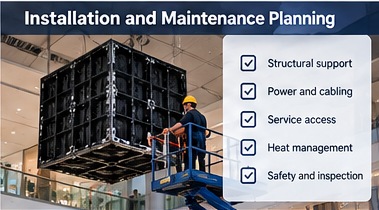
A cube concentrates weight and cabling into a small structure. Suspended installations require engineering approval for the complete load, including cabinets, frame, power equipment, cables and safety hardware. Floor-mounted units need a stable base, controlled public access and protection against impact. The installation drawing should show lifting points, cable exits, ventilation paths and the sequence for removing each serviceable part.
The Minneapolis–St. Paul International Airport signage programme is not a Longcheng cube project, but it provides a useful operational lesson. Its centrally managed display network was designed so messages from different sources could be placed across assets when needed. AVIXA’s project account also reports more than 800 flat panels in the broader airport footprint. The lesson for a cube is that hardware becomes more useful when content ownership, scheduling and emergency-message rules are defined as part of the system—not after installation.
Confirm whether modules, receiving cards and power supplies can be reached without dismantling the entire object. Keep labelled spare modules from the original production batch because later replacements may show color differences. A written service and repair plan should identify safe access equipment, fault-isolation steps, spare quantities and response responsibilities. For a suspended cube, the cost of a lift and site closure can exceed the price of the failed component.
Compare total ownership cost over the intended operating period. Include LED faces, internal frame, mounting or suspension, processor capacity, media player, power distribution, installation labor, access equipment, content adaptation, calibration, spare parts, electricity and scheduled maintenance. Also price the operational consequence of downtime. The cheapest hardware quotation may be the most expensive option if routine repairs require removing the full cube.
Set baseline and post-installation measures that match the location. Retail teams can track dwell time, entry rate, promotion scans and campaign sales. Event operators can track sponsor inventory, content-change labor and reuse frequency. Wayfinding applications should measure repeated questions or missed directions. ROI is strongest when the cube replaces recurring print and labor costs or creates saleable media inventory; visual novelty alone is not a financial result.
A successful cube LED display begins with audience routes and measurable communication goals. Select the active faces, physical size and pixel pitch together; then lock the face resolutions, corner-safe content template, structural design, power layout and maintenance route. Ask for an assembled factory test and a complete bill of materials before shipment. This sequence controls installation surprises, protects uptime and makes the final cube easier to operate across repeated campaigns.
No. A finer pitch is valuable for close viewing and detailed content, but it raises pixel count and system cost. Choose it only when the viewing distance and content justify the difference.
Yes, if the controller, processor and content workflow are designed for independent outputs. Mirroring one source is simpler and may reduce production workload.
Provide the cube size, active faces, mounting height, viewing distance, indoor conditions, content inputs, operating hours, service access, destination and required completion date.











Leave a comments