
Nullam dignissim, ante scelerisque the is euismod fermentum odio sem semper the is erat, a feugiat leo urna eget eros. Duis Aenean a imperdiet risus.
Loading
Nullam dignissim, ante scelerisque the is euismod fermentum odio sem semper the is erat, a feugiat leo urna eget eros. Duis Aenean a imperdiet risus.
 author
 The indoor LED display market in 2026 continues to evolve at a measured but decisive pace. Industry data indicates the global LED display sector approaches approximately $9.86 billion this year, while the fine-pitch indoor segment demonstrates more robust momentum, registering compound annual growth rates in the 5.5–6.8% range through the end of the decade. Screens with pixel pitches below 2.5 mm—and increasingly below 1.5 mm—now dominate specifications for corporate boardrooms, network operations centers, high-end retail environments, and worship facilities where viewing distances are typically short and image fidelity is non-negotiable.
Procurement decisions frequently reveal recurring challenges. Installations completed in the past two to three years often reveal elevated energy consumption, unexpectedly high maintenance requirements, or performance limitations when handling contemporary 4K and 8K content streams. Observations gathered from numerous recent deployments across control rooms operating continuously, retail chains refreshing digital signage, and hybrid meeting spaces highlight these issues with consistency.
The following guidance distills patterns observed in field projects and reflects current technological realities. Emphasis rests on factors that materially influence long-term performance and economics: total cost of ownership, adoption of COB packaging, the rise of all-in-one architectures, and intelligent power management. Application of these considerations typically results in systems that deliver sustained visual quality while containing operational expenditure.
Deployments executed during 2024–2025 reveal several structural shifts that define specifications in 2026.
COB (Chip-on-Board) technology has transitioned from specialized applications to the prevailing choice in fine-pitch indoor installations. In projects requiring pixel pitches below P1.5 mm, COB now constitutes the majority of new high-specification systems. Direct bonding of LED chips to the substrate eliminates individual packaging vulnerabilities, yields superior contrast ratios, and produces uniform black levels essential in environments demanding accurate shadow detail.
All-in-one integrated cabinets have experienced accelerated adoption. These factory-assembled units, commonly sized between 135 and 163 inches with native 16:9 aspect ratios, reduce on-site integration time substantially. Corporate, educational, and retail projects frequently complete installation within a single workday, bypassing the complexity of separate sending cards, processors, and cabling runs. Market indicators place annual growth in this category near 42%.
Energy efficiency has become a primary evaluation criterion. Rising utility costs combined with tightening environmental standards drive specification of architectures that reduce power draw. COB and flip-chip designs routinely achieve 30–50% lower consumption compared with equivalent older SMD configurations at comparable brightness levels. Ambient light sensors enabling automatic brightness adjustment appear in the majority of recent enterprise-grade installations, delivering measurable reductions in energy use during periods of lower ambient illumination.
Minimum performance thresholds for refresh rate and grayscale have solidified. Systems operating below 7680 Hz refresh frequently exhibit visible artifacts during rapid motion sequences or under camera capture—conditions increasingly common in extended-reality previews, live-streamed events displayed indoors, and continuous monitoring applications. Sixteen-bit or higher grayscale processing remains necessary to maintain smooth tonal transitions without contouring, particularly in medical visualization, broadcast reference monitoring, and premium retail presentations.
Front-service magnetic module designs and networked intelligence features have become expected capabilities. Installations involving recessed or wall-integrated mounting now mandate full front access to facilitate module replacement without structural disassembly. Connectivity supporting integration with environmental sensors, automated content triggering, and centralized remote management appears routinely in specifications for intelligent building projects.
These field-derived observations inform the structured recommendations that follow.
Specifications determined solely by upfront quotation frequently lead to suboptimal outcomes. Across operational lifecycles of five years or more, energy consumption combined with maintenance and service interventions typically represents 60–65% of total expenditure. Configurations employing older SMD architectures often generate higher cumulative costs due to elevated power requirements and more frequent module-level repairs.
A straightforward calculation provides clarity: multiply average power consumption per square meter by projected daily operating hours, apply the local electricity tariff, extend across the intended service period, and incorporate anticipated service frequency. Systems incorporating low-power COB designs consistently demonstrate 30–50% reductions in the energy component of this equation. Accounting for opportunity costs associated with downtime further amplifies the advantage of higher-efficiency selections, with payback periods commonly falling between 18 and 36 months.
Traditional SMD packaging, while historically reliable at coarser pitches, exhibits limitations when pixel spacing narrows below P2.0 mm. Batch-to-batch color consistency degrades, mechanical vulnerability increases, and contrast performance suffers in lower ambient light conditions. Deployments from recent years indicate COB has become the standard in applications requiring high reliability and visual precision.
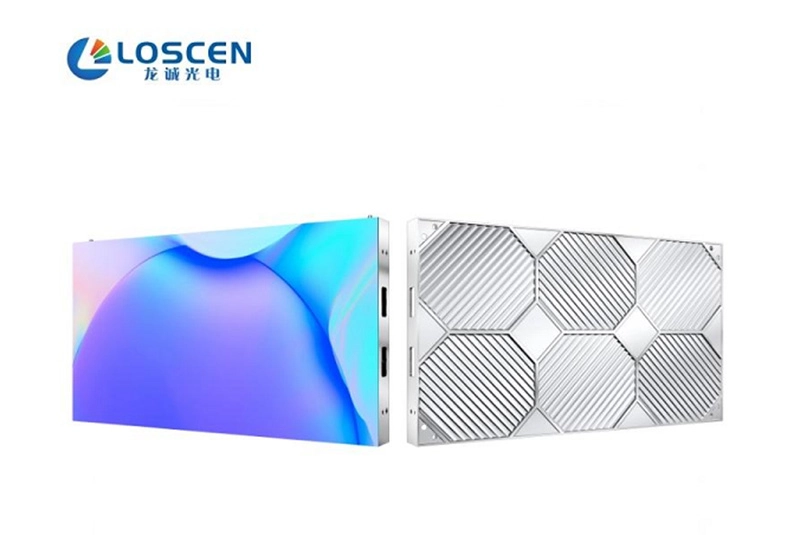
MicroLED variants extend these advantages toward pitches of P0.9 mm and finer, offering extended operational life and improved thermal characteristics. For viewing distances below three meters, pixel pitches of P1.0 mm or tighter using COB deliver appropriate resolution without excessive cost. Distances between three and eight meters align well with P1.2–P1.5 mm COB or MiniLED-hybrid configurations.
The complexity inherent in assembling discrete cabinets, external processors, and supporting infrastructure has diminished the appeal of traditional video-wall builds in many scenarios. All-in-one units arrive pre-calibrated, incorporate integrated media players (frequently Android-based), support wireless presentation protocols, and offer optional touch interactivity. Recent corporate rollouts and retail implementations report installation durations reduced from days to hours. Specifications should verify native 16:9 aspect ratios, full 4K signal compatibility, and efficient content-update pathways.
Empirical rules remain effective for rapid specification. The current industry benchmark multiplies pixel pitch (expressed in millimeters) by a factor of 800–1000 to approximate the minimum comfortable viewing distance in meters. A P1.2 mm display therefore supports viewing from approximately 0.96–1.2 meters before pixel structure becomes perceptible. Conference environments with typical seating distances of 2–5 meters align effectively with P1.5–P1.9 mm pitches. Applications requiring closer inspection, such as retail display cases or detailed monitoring, necessitate P0.9–P1.2 mm COB solutions.
Excessive brightness specification for indoor environments results in unnecessary power consumption and viewer discomfort. Contemporary deployments standardize in the 600–800 nit range under typical office, retail, and auditorium lighting conditions. Incorporation of integrated ambient light sensors that dynamically modulate output has become prevalent, achieving energy reductions of up to 40% during periods of reduced illumination. On-site verification using portable lux measurement devices frequently reveals discrepancies between manufacturer claims and actual delivered performance.
Content streams incorporating high-frame-rate video, rapid graphical transitions, or camera-sourced material expose limitations in lower refresh-rate systems. Artifacts including moiré patterns and temporal flicker emerge under these conditions. Current specifications for demanding applications mandate refresh rates of 7680 Hz or higher paired with 16-bit grayscale depth to preserve gradient integrity across skin tones, shadows, and subtle color shifts.
Installations incorporating recessed mounting or architectural integration render rear access impractical. Industry practice in 2026 strongly favors designs permitting 100% front maintenance. Magnetic modules that detach and reattach rapidly—ideally tool-free and manageable by a single technician—substantially reduce service-related downtime and associated costs, often by 60–70% over the system lifecycle.
Standalone display functionality increasingly limits utility in connected environments. Specifications now routinely require integration with building management systems, environmental sensors, and centralized control platforms. This capability enables automated content adaptation based on real-time inputs and supports remote diagnostics and firmware management across distributed installations.
Extended warranty periods occasionally appear in marketing materials, yet practical support capability determines actual reliability. Evaluation should focus on parts availability, documented response times, and presence of regional service infrastructure. In competitive market conditions, suppliers maintaining local inventory and rapid-response protocols demonstrate materially lower risk of extended outages.
Structured comparison mitigates bias toward lowest initial cost. A balanced evaluation framework allocates approximately 30% to core technical performance (pixel pitch, refresh rate, uniformity metrics), 25% to projected five-year total cost of ownership, 20% to warranty and service provisions, and 25% to alignment with prevailing 2026 technological directions (COB adoption, all-in-one architecture, energy efficiency features). Application of this methodology across vendor quotations consistently identifies options offering superior long-term value.
Shenzhen Longcheng Photoelectric Technology Co., Ltd., founded in 2013 and headquartered in Bao’an District, Shenzhen, specializes in the research, development, and production of LED display systems. The company maintains a comprehensive portfolio encompassing fine-pitch fixed-installation and rental solutions tailored for conference facilities, auditoriums, command centers, retail applications, and additional professional environments. Manufacturing processes adhere to ISO9001 standards, with products certified under CE, ROHS, FCC, and related international requirements. Systems have been deployed across more than 120 countries and regions, supporting a client base exceeding 900 organizations through established distribution and service channels. About Us
Specification of indoor LED displays in 2026 demands attention to factors that extend beyond initial visual impact. Systems incorporating COB packaging, integrated all-in-one designs, adaptive power management, and intelligent connectivity consistently demonstrate advantages in operational reliability, energy consumption, and maintenance simplicity. Thorough assessment of total ownership economics, adherence to contemporary performance thresholds, and objective comparison of available options position procurement decisions for sustained performance rather than short-term appeal. Mapping project-specific requirements—spatial constraints, content characteristics, usage patterns, and budgetary parameters—against these established criteria yields solutions that deliver consistent image quality and controlled lifecycle costs.
Conference room viewing distances typically range from 2 to 5 meters. Pixel pitches between P1.5 mm and P1.9 mm provide adequate resolution while maintaining reasonable economics. Closer seating arrangements (1–2 meters) benefit from P1.2 mm or finer COB-based systems to eliminate perceptible pixel structure.
COB architecture bonds LED chips directly to the substrate, resulting in improved contrast performance, reduced susceptibility to mechanical damage, and enhanced uniformity. Recent deployments in control rooms, broadcast facilities, and retail environments demonstrate that COB maintains superior black levels and color consistency over extended operational periods compared with SMD at equivalent fine pitches.
Refresh rate remains a decisive factor for applications involving video content, dynamic graphics, or camera capture. Systems operating at 7680 Hz or higher prevent visible flicker and moiré effects during rapid motion, conditions frequently encountered in hybrid meeting environments, extended-reality demonstrations, and continuous surveillance monitoring.
All-in-one solutions suit the majority of corporate, retail, and educational deployments up to approximately 200 inches. These units offer simplified installation, integrated processing, and reduced cabling requirements. Custom video wall assemblies remain appropriate primarily for non-standard aspect ratios or significantly larger-scale applications where configurability outweighs deployment efficiency.
Brightness levels of 600–800 cd/m² accommodate typical indoor lighting scenarios in offices, retail spaces, and auditoriums without producing glare or excessive power draw. Integration of automatic ambient light compensation further reduces energy consumption during periods of lower illumination, a feature now standard in most professional-grade installations.










Leave a comments